Preschoolers’ Speech Development
Preschoolers’ speech development is fabulous. From the ages of 3 to 5 children progress from simple sentences to using increasingly more complex and creative sentences in their speech. It is an awesome time of growth and learning. Language skills extend to children’s cognitive, emotional and social development.
Language acquisition and the patterns of learning children develop throughout the preschool years prepare them for the next exciting step – starting primary education and learning to read.
Preschoolers are active learners and they learn best through hands-on learning activities, exploration and play.
Promoting Speech Development
The best way to boost speech development is through talking, communicating, playing and reading to children in the course of a balanced day.
Preschoolers love long conversations with adults and other kids – they love making friends. They are keen, enthusiastic, and thrive on encouragement, challenges and acknowledgment of their achievements.
Speech and Language Milestones
Before the age of six most children can:
- Follow a two-part instruction: “Pick up the ball and throw it to me.”
- Sort objects into groups by colour, shape and size
- Know words of numbers as they count in sequence to 10 or more
- Understand the concept of two, three, four, five or more and share out objects to a group of children
- Use words and sentences to express needs, questions and feelings
- Relate experiences from past experieces
- Relate a story from a sequence of two to four pictures
- Project information into the future, for example: “If you blow up a balloon too much, it will burst.”
Overgeneralising in Speech Development
Children become increasingly imaginative in their use of words, phrases and sentences. They make many grammatical discoveries. A child may say:
- “I goed on a plane,” instead of: “I went on a plane.”
- “We swimmed in the pool,” instead of: “We swam in the pool.”
- “My feets are wet,” instead of: “My feet are wet.”
- “There are six mouses in the picture,” instead of: “There are six mice in the picture.”
It shows that children are beginning to work out and apply rules of grammar. After all:
- We add –ed to regular verbs liked played and climbed
- We add – s to regular plural nouns
When children overgeneralise it shows that speech develoment is progressing well. Children still need to discover that some irregular verbs are different and some nouns have different plural forms.
We help children self-correct their use of language by:
- Modelling correct forms rather than telling children to use the correct form
- Allowing children to complete their sentences and train of thought without interrupting.
When they have have finished telling us their stories, we repeat the sentence back to them, emphasising the correct form, for example: “You went on the plane, how exciting!”
Story Time Builds Language Skills
Preschool aged children are naturally curious and adventurous. They love to ask a lot of questions about anything and everything. Their most frequently asked questions begin with “Why?”, “How?” and “When?”
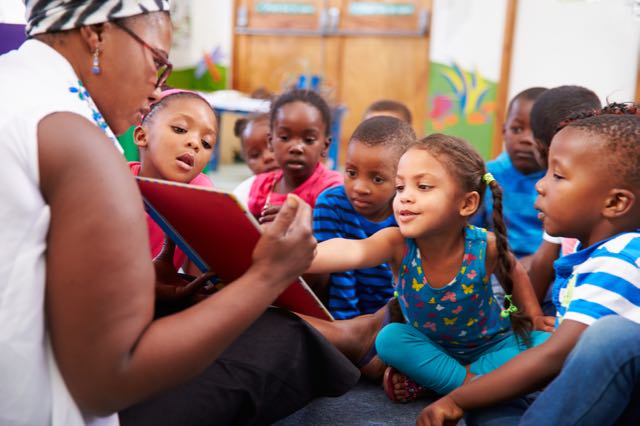
Story time in preschool offers a wonderful way to stretch children’s vivid imaginations and look for all the answers. It also helps preschoolers discover interesting words to describe people, animals, colours, shapes, numbers, emotions, actions and directions. Children really enjoy:
Children may want to listen the same stories over and over again. They discover something new in each re-reading of the story. Repetition, rhymes and love of stories boost children’s developing early literacy skills.